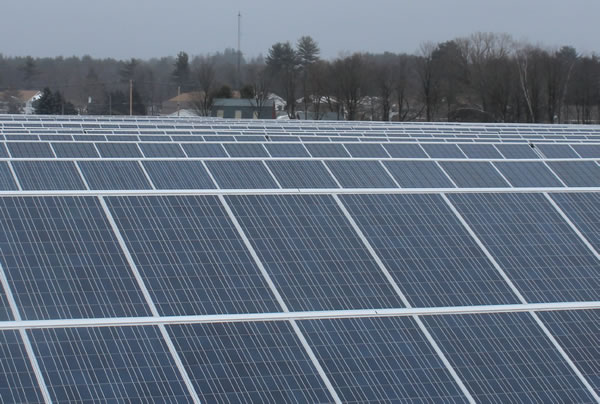
While the United States is rich in renewable resources for the production of green electricity, expansion and modernization of the North American power grid will be required to transmit that power to where it is needed.
Superconductor Electricity Pipelines: An Optimal Long-Haul Transmission Solution
Jack McCall - American Superconductor Corp
- Highest power capacity
- Highest efficiency (lowest power losses) of any transmission technology
- Ideal for very long distances
- Capable of transferring power across the three U.S. interconnections
- Able to accept power from multiple distributed sources, and precisely deliver power to multiple distributed destinations
- All underground construction with very small (25’) right of way requirement.
- Simplified cost allocation due to precise controllability of DC terminals.
- Minimizes interaction with existing AC grid, reducing costs and increasing operational flexibility
Wind and solar power today account for a relatively small portion of electricity generation in the U.S. Those ratios, however, will rise rapidly as the country, like others around the world, increasingly turns to renewable sources to meet rising power demands and reduce CO2 emissions. The inability of America’s existing transmission system to move clean electrical energy from the country’s rural heartlands where it is generated to the high-demand urban load centers remains a primary barrier to achieving the 15-25% renewable energy objectives being outlined by the Obama Administration and Congress. In order to continue developing renewable resources, the North American electric power grid must be expanded and reconfigured to facilitate the challenge of moving large amounts of electricity over these very long distances.
The scope of this leading energy challenge will encompass the transmission of 100 gigawatts (GW) or more of green power. Networks of interstate, overhead 765 kV power lines that would require rights of way hundreds of feet wide are one solution actively being considered to achieve this objective. In addition to the significant impact to the nation’s aesthetic landscape, this traditional approach could require significant eminent domain activity and have a rather significant environmental impact.
.jpg)
Superconductor Electricity Pipelines offer many unique advantages. They combine the advantages of direct current (DC) superconductor cables and voltage source converters (VSC) to deliver gigawatts of electricity from multiple generation sites to multiple load centers. Superconductor Electricity Pipelines are easy to site, highly efficient, controllable and offer greater security than competing technologies.
Unlike overhead power lines, Superconductor Electricity Pipelines are deployed underground utilizing conventional pipeline construction techniques. These systems require a corridor just 25 feet wide and can be located along existing transportation rights of way, thereby eliminating or greatly reducing the need for complex, contentious and costly siting procedures. For example, railroads, gas pipelines and the medians of interstate highways can easily accommodate the co-location of DC superconductor cables.
When compared to 765 kV overhead lines for long-haul transmission projects on the order of 1,000 miles for a 5 GW transmission load, Superconductor Electricity Pipelines:
- Improve Aesthetics: Conventional high voltage towers are more than 100 feet tall and can potentially impact the aesthetics of neighborhoods, national parks and sensitive wildlife areas. Superconductor Electricity Pipelines are out of sight and out of mind. Unlike overhead power lines, they also are free from electromagnetic fields.
- Enhance Efficiency: Superconductor Electricity Pipelines are able to cut power losses by two to three times compared to conventional transmission options. This results in improved return-on-investment and reduced carbon emissions.
- Simplify Cost Allocation: Cost sharing for new AC transmission lines is a significant challenge due to the difficulty in determining the benefit each affected electric utility receives. The power supplied to and delivered from Superconductor Electricity Pipeline DC-AC on- and off-ramps enables much simpler cost allocation.
- Are Cost Competitive: When looking at the thousand-mile, multi-GW transmission runs required to transport renewable energy from America’s heartlands to its cities, Superconductor Electricity Pipelines are comparable in cost to 765 kV AC overhead transmission lines.
- Increase Security: Ice storms, hurricanes, tornadoes, vandalism and terrorism are just a few of the threats to overhead power lines. Any of these incidents can cut power supplies to distant cities for lengthy periods of time with serious impact to public security and the U.S. economy. Given their underground location, Superconductor Electricity Pipelines are out of harm’s way and safely shielded from these threats.
Comments (2)
Posted by Mike Rakestraw on 08/12/09, 11:43 AM
This is real cool! (pun)... A real basic question regarding the superconductor (HTS) wire technology, what happens when the wire develops a liquid nitrogen gas leak, self healing, or ??
Posted by Robert Munck on 08/11/09, 01:49 PM
I'm curious why the article doesn't mention the possibility of pumping liquid hydrogen in the underground pipe, both to cool the superconductor and to transmit an approximately-equal amount of energy in the H2. The "SuperGrid" has been fairly widely discussed. Of course, LH2 is significantly colder and harder to handle, but its use also may make it possible to use cheaper (lower-temperature) superconductors. Also, don't you end up STORING a considerable amount of energy in a long superconductor, in its EMF? Energy storage is much needed.