It's not fun to think about but when our earth's natural and mostly
free resources diminish they must be gradually replaced with sustainable
manufactured or produced products in order to continue our successful
habitation of this planet. Ocean fish populations, for example, have
been greatly diminished because of increased worldwide consumption.
Consequently, fresh and seawater fish production are now gradually
replacing former ocean fish inventories. The southern half of Florida is
now experiencing initial seawater intrusion of its massive freshwater
underground aquifers due to excessive groundwater pumping. Over time
these groundwater resources will have to be gradually augmented with
sustainable manufactured freshwater such as that produced by
desalination technology. The fossil fuels of coal, crude oil, and
natural gas represent additional examples of gradually diminishing
resources which must eventually be completely replaced with sustainable
manufactured products. Fossil based products produce electricity,
transportation fuels, heating oils, lubricants, and petrochemicals.
So what's going to replace fossil based fuels and when? Let's review
the several existing options from the combined purviews of science and
cost.
|
Sustainable
Resource |
Can Produce |
Comments |
|
Wind |
Electricity |
Up to maximum of 2% electricity
replacement possible due to limited wind availability. |
|
Hydroelectricity |
Electricity |
Up to maximum of 2% electricity
replacement due to limited eligible water. |
|
PV Solar |
Electricity |
Excellent for special
applications but otherwise considered far too expensive for
massive application. |
|
Tidal Waves |
Electricity |
Potentially excellent
technology for distributed generation on small scale bases. Not
possible for massive generation due to limited qualifying tides. |
|
Ethanol |
Transportation Fuel |
Its existing use as a gasoline
fuel oxygenate is frequently challenged as uneconomical because
of the significant Governmental subsidies which underwrite the
market. |
|
Hydrogen Gas |
Transportation Fuel |
According to the USDOE,
hydrogen requires twice as much energy as electricity, or twice
the tonnage of coal, or twice the number of nuclear plants, or
twice the field of PV panels to perform an equivalent unit of
work. Its future general use appears to be scientifically
challenged and its infrastructure must yet be built. The
National Academy of Sciences concluded in a report dated
February 4, 2004, that it will be "…many decades at best before
hydrogen technology can contribute significantly to fixing
America's oil import and global warming problems." |
|
Methane Gas |
Electricity and Transportation
Fuel |
Can be produced from anaerobic
digestion of organic matter and organic wastes. CNG and LNG are
quite excellent transportation fuels environmentally but
somewhat costly because of their inherently low Btu value.
Their infrastructure is now under construction. |
|
Biodiesel |
Electricity, Transportation Fuels, Lubricants, and Greases |
Highly
suitable for cars, trucks, airplanes, ships, and trains. No
oxygenate required. May also be further refined into
biolubricants and biogreases. The infrastructure for biodiesel
already exists. |
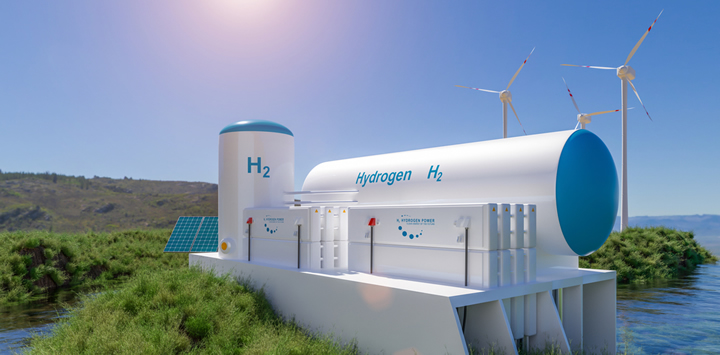
Hydrogen gas has received enormous attention recently because of the
believed potential of Solar Hydrogen. Solar hydrogen refers to any
method of production that uses the power of the Sun to produce and
collect usable hydrogen. The most likely approach proposed is:
1. Energy collection utilizing parabolic solar collectors that focus
and concentrate the light energy of the Sun.
2. Applying the collected energy to a Stirling-cycle heat engine
which, in turn, drives an electricity-producing generator to power an
electrolysis system.
3. Electrolysis systems use electricity to chemically decompose water
into its component elements of hydrogen and oxygen. Free hydrogen
doesn't exist in sufficient quantities to support a hydrogen based
transportation fuel.
4. The solar hydrogen is then used as an environmentally clean fuel
to power transportation equipment.
While technically possible, Solar Hydrogen technology still must have
its infrastructure developed and thereafter compete competitively with
other biofuels such as biodiesel. A hydrogen fueled car currently costs
the equivalent of $4.00/gallon gasoline. Lowering this cost
significantly appears to be scientifically difficult. Biodiesel, by
comparison, is currently in the $1.50/gallon range and heading lower.
A gasoline engine is about 25% efficient in converting Btus into work
(joules). A diesel engine, by comparison, is about 43% efficient. When
converted into actual distances, each and every 100 gasoline miles is
the near equivalent of 172 petroleum diesel (petrodiesel) or biodiesel
miles. These facts are ever present driving forces which favor the use
of far more efficient diesel engines.
As a diesel engine fuel, biodiesel is an environmentally preferred
and a performance equal to petrodiesel. If refined from waste vegetable
oils and fats, it is price competitive with petrodiesel and consequently
now being sold in the marine, transportation, and mining industries as
well as for heating oil. If refined from virgin vegetable oils, however,
it is not price competitive and therefore not being sold as a 100%
replacement of petrodiesel. It is, however, currently being sold as a
blend component of petrodiesel because of its extremely favorable
influence on environmental emissions. A blend as low as 2% biodiesel
provides a dramatic positive effect on the overall performance of a
diesel engine which is strong evidence of its excellent fuel
characteristics.
The production cost of biodiesel consists of the cost of vegetable
oil acquisition or production plus the cost of its subsequent refining.
There isn't a great deal of improvement possible with vegetable oil
acquisition or production as most of the some 50 vegetable oils marketed
are already fully established worldwide commodities. The cost of
biodiesel refining, however, is susceptible to significant improvement
if the associated refining biowastes are converted into energy through
anaerobic digestion technology. The energy produced has significant
value which, when credited to the biodiesel refining process, greatly
reduces the bottom line cost of biodiesel production.
Biodiesel is efficiently produced by a chemical process called
transesterification whereby raw glycerine is removed from vegetable
oils. Raw glycerine must then be further purified before it can be
marketed. Because of a continuing worldwide glycerine glut, raw
glycerine may be far better managed as a biowaste residual of biodiesel
refining rather than a salable commodity. And whether the vegetable oils
are obtained by crushing or steam extraction there are always additional
biowaste residues all of which may be anaerobically digested to produce
methane gas. Methane gas can be efficiently converted into steam and
electricity, both of which can be holistically and beneficially used in
the refining of biodiesel. In addition to methane gas, anaerobic
digestion systems can generate carbon dioxide gas, organic fertilizer,
liquid fertilizer concentrate, and reverse osmosis permeate water, all
of which are salable commodities and therefore added value co-products
in the refining of biodiesel.
Biodiesel is a pure 100% fuel conforming to ASTM Specifications D
6751. It is referred to as B100 or "neat" biodiesel. A biodiesel blend
is pure biodiesel blended with petrodiesel. Biodiesel blends are
referred to as BXX. The "XX" indicates the amount of biodiesel in the
blend. A B20 blend, for example, is a 20% volumetric blend of biodiesel
with 80% petrodiesel. B20 easily meets ASTM Specifications D 975.
Biodiesel and biodiesel blends have excellent solvent properties. In
some cases, the use of petrodiesel, especially No.2 petrodiesel, leaves
a deposit in the bottom of fuel lines, tanks, and delivery systems over
time. The use of biodiesel can remove these deposits and sediments. This
results in the need to change filters more frequently when first using
biodiesel until the entire fuel delivery system has been cleaned. This
same phenomenon is frequently observed when switching from No.2 to No.1
petrodiesel.
B20 raises the pour point, cloud point, and cold filter plugging
point (CFPP) cold weather properties of petrodiesel at least 1.67°C
(3°F). Biodiesel anti-gel products are available that can efficiently
and effectively lower the CFPP of B20 as low as -40°C (-40°F). Fuel
filter and line heaters can also be used to lower the CFPP even further.
Neat biodiesel should be transported and stored at temperatures above
10°C (50°F) to guard against gelling.
Biofuels include ethanol, hydrogen, methane, and biodiesel. All are
derived from renewable biological sources. All directly support local
agricultural economies on a sus- tainable basis. All generate less
pollution than petroleum based fuels. Compared with petrodiesel,
biodiesel:
- Is cleaner burning,
- Is odor free, non-toxic, and biodegradeable,
- Is free of sulfur, ,
- Is safer for people and the environment,
- Reduces EPA targeted emissions,
- Achieves more complete fuel combustion,
- Is safer to handle, transport, and store,
- Has higher lubricity,
- Reduces black smoke,
- Eliminates the nauseating smell,
- Has a flash point above 150°C (302°F) and therefore exhibits a
lesser potential for explosion,
- Reduces greenhouse emissions, and
- Is a plant-based fuel replacement.
According to the USEPA, biodiesel has additional and multiple
benefits as follows:
|
Emission benefits
|
Biodiesel reduces particulate matter, carbon monoxide,
sulfur dioxides, and total hydrocarbon emissions.
|
|
Engine
power |
Is
virtually the same as petrodiesel (128,000 vs. 130,500 Btus/gallon).
Engine torque and horsepower therefore remain virtually the
same. |
|
Conversion and engine adjustments
|
None
required. A changeover to biodiesel or biodiesel blends does
not require any engine conversion or adjustments.
|
|
Cetane
number
|
Higher
than petrodiesel (49-62 vs. 42 for No.2 diesel fuel).
Higher cetane values contribute to reduced engine knocking
and smoother running. |
|
Fuel
consumption |
Similar
to petrodiesel. |
|
Lubricity
|
Much
higher and when blended with petrodiesel compensates for the
loss of lubrication with the new low-sulfur and CARB
(California Air Resources Board) petroleum diesel fuels.
|
|
Winter
conditions |
Existing diesel fuel winterizers can be used with biodiesel
and biodiesel blends. |
|
Handling and storage
|
Is
safer than petrodiesel to handle and store. Biodiesel does
not produce dangerous vapors at normal ambient temperatures,
and can be stored in the same containers and tanks as
petrodiesel. |
|
Environmental considerations
|
Is
safer for the environment than petrodiesel. Is also less
toxic than table salt, is as biodegradeable as sugar, and
contains no carcinogenic aromatics. |
|
Availability and supplies
|
Biodiesel is available now. Currently, North America
produces a surplus of 22 billion total pounds of vegetable
oils, lard, and tallow that is available for biodiesel
production. |
|
Lifecycle carbon dioxide |
Is
reduced by 78%.
|
|
Energy
security
|
Biodiesel produced from domestic renewable resources
supplements the world's petroleum supplies and helps ensure
America's energy security. |
Energy security
Biodiesel produced from domestic renewable resources supplements the
world's petroleum supplies and helps ensure America's energy security.
Politically, The Energy Policy Act (EPAct) of 1992 requires most
federal, state, and public utility companies to have certain percentages
of alternative fuel vehicles (AFVs) in their fleets. Since biodiesel
works in any diesel engine with few or no modifications, EPAct was
amended in 1998 to allow fleets to gain AFV credits through biodiesel
use. Every 450 gallons of biodiesel purchased counts as one AFV credit.
Fleets are, however, limited to using biodiesel for 50% of their
credits. This 50% restriction is now under review. In addition to the
EPAct provision, the Senate's energy package includes a provision that
would give a one cent reduction in the fuel excise tax for every one
percent of biodiesel blended into standard diesel fuel up to a B20 blend
for three years.
Biodiesel would also be an eligible fuel to participate in a program
that calls for the nation to increase use of renewable fuels. This
provision calls for the United States to use 5 billion gallons of
renewable fuels by the year 2010. There exists a strong petroleum
industry lobby opposed to the promotion and usage of alternative fuels.
Despite this, use of biodiesel in the United States is increasing,
particularly in urban bus fleets. Production costs for biodiesel are
currently about 2.5 times that of petrodiesel.
Fuels derived from renewable biological resources for use in diesel
engines are known as biodiesel fuels. Animal fats, virgin and recycled
vegetable oils derived from crops such as soybeans, canola, corn,
sunflower, and some 30 others can also be used in the production of
biodiesel fuel. Tall oil produced from wood pulp wastes is yet another
possible feedstock source. Biodiesel was used as a diesel fuel as early
as 1900 when Rudolf Diesel demonstrated that a diesel engine could be
run on peanut oil. Chemically, biodiesel is the methyl or ethyl alkyl
esters of long chain fatty acids derived from renewable lipid sources.
It is generally produced in a several stage batch process. The process
begins by dissolving the catalyst (sodium or potassium hydroxide) with
methyl or ethyl alcohol using a standard agitator. The alcohol/catalyst
mixture is then added to a closed reaction vessel and the vegetable oil
(or fat, or beef tallow, or pork lard) is/are then added. The reaction
process from this point on is closed from the atmosphere and kept around
71°C (160°F) for 1-8 hours. Once the reaction is considered complete,
two major products exist namely biodiesel and glycerine. Each has an
excess amount of alcohol previously used in the reaction phase. The
glycerine phase is much denser than the biodiesel phase. After these two
products are separated the alcohol is removed by distillation. The
glycerine is neutralized with an acid and sent to storage as crude
glycerine. Once separated from the glycerine the biodiesel is purified
by washing with warm water (referred to as the methyl ester wash) to
remove residual catalysts or soaps, dried, and then sent to storage.
The National Biodiesel Board (NBB) is a trade association of the
soybean industry located at PO Box 104898, Jefferson City, MO
65110-4898, Phone: 800.841.5849, Fax: 573.635.7913, URL:
www.biodiesel.org. NBB serves as the product development team for
biodiesel within the United States coordinating the research,
regulatory, and market development programs needed to commercialize
biodiesel. Its membership base includes fuel marketers and related
feedstock producing and marketing associations. NBB's research is
focused on biodiesel fuel, its characteristics, its economics, and
diesel engine testing for emissions and non-emissions work. NBB's market
de- velopment program is focused on federal and state regulatory work
and market development through the education of the industry and end
users. The United States, Europe, New Zealand, and Canada have conducted
tests of biodiesel on trucks, cars, locomotives, buses, tractors, and
small boats. Testing has included the use of pure biodiesel and various
blends with conventional diesel engines. Results indicate significantly
reduced engine wear while performance remains virtually unchanged. Many
tests have concluded that the best overall results are obtained with a
B20 blend.
Economics of Biodiesel and Petrodiesel Production
The prices of feedstock used in the production of biodiesel relative
to petrodiesel is a key determinant in the price competitiveness of
biodiesel. The economics of biodiesel production have deteriorated since
1994 for two main reasons:
First, low agricultural commodity inventories (notably corn and
wheat), drought conditions in some production areas and increasing
demand for grains and oilseeds has resulted in a significant increase in
commodity prices in the last few years. While there is expected to be
some price moderation in the short-run, it is not anticipated that grain
prices will decline in the foreseeable future to the levels prevailing a
few years ago.
Second, petroleum prices have declined several dollars per barrel in
late March 1996 to just under US$16/bbl. Much of the impetus for the
decline resulted from the recent agreement between the United Nations
and Iraq, which allows that country to reenter the market as a supplier.
Other petroleum producing nations have indicated they will not be
reducing their output to compensate for Iraqi's production. Therefore,
total oil market supply will increase and prices could decline even
further. Over the long term, however, agricultural inventories and the
price of petroleum will both likely increase because the ongoing trend
for both points upward. Currently, biodiesel is a technically acceptable
substitute, replacement, or blending stock for conventional petrodiesel,
but that its cost may only make economic sense where alternative fuel
vehicle purchases are required by federal law and where alternative
fuels are required by law to be used by certain regulated fleets. The
cost of using biodiesel is quite economical when compared to the total
cost to use other alternative fuels.
For all practical purposes, the performance of the virgin and
recycled oil biodiesel products are identical. The marketplace price of
the recycled oil is, however, significantly less than the virgin oil
product. If all the existing production of virgin and recycled oil were
made into biodiesel and sold, the sales would replace less than 2% of
petrodiesel sales. Virgin soy oil costs about 20¢/lb which translates
into a soy biodiesel price of about $2.00/gallon whereas virgin mustard
seed oil, a low value waste product, costs about 10¢/lb which translates
into a mustard biodiesel price of about $1.00/gallon. If the waste or
recycled oil is free to the producer, the final price of the biodiesel
is about $0.83/gallon utilizing existing technology.
Many Crops Yield Vegetable Oils As Follows:
|
Crop |
kg oil/ha |
L oil/ha |
lbs oil/acre |
gal oil/acre |
|
corn |
145 |
172 |
129 |
18 |
|
cashew nut |
148 |
176 |
132 |
19 |
|
oats |
183 |
217 |
163 |
23 |
|
lupine |
195 |
232 |
175 |
25 |
|
kenaf |
230 |
273 |
205 |
29 |
|
calendula |
256 |
305 |
229 |
33 |
|
cotton |
273 |
325 |
244 |
35 |
|
hemp |
305 |
363 |
272 |
39 |
|
soybean |
375 |
446 |
335 |
48 |
|
coffee |
386 |
459 |
345 |
49 |
|
linseed |
402 |
478 |
359 |
51 |
|
hazelnuts |
405 |
482 |
362 |
56 |
|
euphorbia |
440 |
524 |
393 |
57 |
|
pumpkin
seed |
449 |
534 |
401 |
57 |
|
oriander |
450 |
536 |
402 |
57 |
|
mustard
seed |
481 |
572 |
430 |
61 |
|
camelina |
490 |
583 |
438 |
62 |
|
sesame |
583 |
696 |
522 |
74 |
|
safflower |
655 |
779 |
585 |
83 |
|
rice |
696 |
828 |
622 |
88 |
|
rung oil
tree |
790 |
940 |
705 |
100 |
|
sunflowers |
800 |
952 |
714 |
102 |
|
cocoa |
863 |
1026 |
771 |
110 |
|
peanuts |
890 |
1059 |
795 |
113 |
|
opium poppy |
978 |
1163 |
873 |
124 |
|
rapeseed |
1000 |
1190 |
893 |
127 |
|
olives |
1019 |
1212 |
910 |
129 |
|
castor
beans |
1188 |
1413 |
1061 |
151 |
|
pecan nuts |
1505 |
1791 |
1344 |
191 |
|
jojoba |
1528 |
1818 |
1365 |
194 |
|
jatropha |
1590 |
1892 |
1420 |
202 |
|
macademia
nuts |
1887 |
2246 |
1685 |
240 |
|
brazil nuts |
2010 |
2392 |
1795 |
255 |
|
avocado |
2217 |
2638 |
1980 |
282 |
|
coconut |
2260 |
2689 |
2018 |
287 |
|
oil palm |
5000 |
5950 |
4465 |
635 |
Vegetable oil yields x 0.8 = approximate biodiesel yields
Biodiesel NOx Control Technology already exists with more under
development. In the fossil fuel power industry ammonia is added to the
hot discharge gas under catalytic influence to convert NOx to Nitrogen
Gas and Water. In a worst case scenario the same technology can be
successfully used to reduce biodiesel NOx emissions to acceptable
levels. One can also retard the timing to achieve acceptable NOx results
at the expense of diesel engine performance if absolutely necessary.
Current Biodiesel Production Plants have directed their marketing
efforts at the blend business with some B100 from used vegetable oil
(with lard, fat, and tallow sometimes added) being sold to the marine
and mining industries. The blend business plants are focused almost
entirely on existing commodity crops of soybean and rapeseed (canola in
Canada) for their feedstock. It is common practice to crush the crop to
separate as much vegetable oil as is possible. The remaining pellets
and/or mash is then beneficially used as animal feed. On the surface,
these practices seem efficient but from chemical engineering and
nutrition standpoints are highly inefficient. Far too much oil is left
in the crop and the utilization of crop residuals as anima! feed, or
feed supplements, in fact represents but a solid waste disposal activity
rather than a scientifically preferred animal nutrition diet.
Additionally, virtually all existing vegetable oil crops are commodities
in the marketplace subject to ever present intermittent droughts,
diseases, and governmental subsidy influences. Consequently, the
marketplace prices of the produced biodiesel are weather and plant
disease dependent. Lastly, the majority of existing biodiesel production
facilities are rather small which adds another level of marketplace
price sensitivity.
As biodiesel begins to replace petroleum diesel (and other kerosenes)
and as the political pressure to increase the miles-per-gallon
efficiency of automobiles, gasoline and gasoline engines will both
disappear as diesel engines are far more efficient than gasoline
engines.
The use of biodiesel will permanently and completely eliminate
foreign oil imports and therefore maximize our national security. The
fuel has no technical, political, or environmental downside.
Agricultural job creation is fantastic. American dollars will stay here
as all associated production requirements of this fuel are accomplished
domestically. The Kyoto requirements will automatically be achieved as
the biodiesel refining process as well as the fuel itself both reduce
carbon dioxide emissions. One can actually end up selling CO2 credits to
other countries, including Japan, which has no oil or coal of its own.
Total time to accomplish the dominance of biodiesel - perhaps 20
years, maybe sooner, depending on the success of its technology
providers.
Somewhat amazingly, neither governmental subsidies nor petroleum
industry cooperation are even necessary. Other biofuels of hydrogen, CNG,
LNG, and ethanol cannot effectively compete because of the much greater
inherently high Btu content of biodiesel. Because the B100 production
technology is so strong, downstream petroleum industry participation
would be expected, welcomed, and even encouraged.
Approximate annual size of the United States and European market for
B100 is $300 billion each when one includes all of the refined products
of biodiesel transportation fuel, biodiesel jet fuel, biodiesel heating
oil, biodiesel lubricating oils, and biodiesel greases.
Today's marketplace is all about renewables. Biodiesel is an
important new player with significant promise. |