
BioSolar to Commercialize BioBacksheet for Thin-Film Photovoltaic Modules
Company to Develop Thin Film Version of BioBacksheet Due to Growing Interest From Thin Film Solar Manufacturers
Santa Clarita, CA - March 9, 2009 - BioSolar, Inc. (OTC BB: BSRC), developer of a breakthrough technology to produce bio-based materials from renewable plant sources that reduce the cost of photovoltaic solar modules, today announced its plan to expand the company's BioBacksheetTM technology to accommodate copper-indium-gallium-selenide (CIGS) and cadmium telluride (CdTe) thin-film modules.
More Headlines
- Solar Photovoltaic (PV) Market to hit $694.5 Billion by 2035
- Tigo Energy Next Gen Software-Enhanced GO Battery Now Available in North America
- Intersolar & Energy Storage North America Unveils Interactive Programming to Enhance Education and Networking
- Intersolar Africa 2026 to Position Nairobi as East Africa's Key Hub for Solar and Energy Storage
- Sungrow Launches Grid-Forming Utility ESS for Europe's Energy Transition

Currently, the company's patent-pending BioBacksheet' technology for crystalline silicon (C-Si) photovoltaic solar cells is in the pre-production phase. Designed to replace petroleum-based components with renewable plant sources, the BioBacksheet' is a premium-grade backsheet consisting of a cellulosic film combined with a highly water resistant and high dielectric strength nylon film made from castor beans.
"At present, the C-Si area is the largest photovoltaic market segment," said Dr. David Lee, BioSolar chairman and CEO. "However, at BioSolar we recognize that the low-cost potential of thin-film modules, particularly CIGS and CdTe, are emerging as formidable competitors in the global solar market and attracting gigantic investments. Many of these thin film PV manufacturers have expressed strong interests for a "green" backsheet to be incorporated into their thin-film solar panels."
In a new solar report forecasting production and comparing technologies, "PV Technology, Production and Cost, 2009 Forecast," Greentech Media analysts report that "companies making cadmium-telluride panels could produce nearly 1.5 gigawatts, or 6 percent, of the global supply by 2012." The report also said that in the same time frame, "companies that make copper-indium-gallium-selenide solar panels could produce 12 percent, or nearly 3 gigawatts, of the worldwide supply of solar panels."
"These products require a backsheet comprising an almost perfect moisture barrier," said Dr. Stanley Levy, BioSolar's Chief Technology Officer. "Currently, glass is the material of choice. It works, but it is heavy and expensive. In response, we have started development on a BioBacksheet with the required barrier properties for this application. It is a composite film consisting of bio-based and 100% recyclable materials. The resulting product is expected to be much lighter than glass as well as lower cost."
"The greatest impediment to solar replacing fossil fuels is cost," said Lee. "Manufacturers struggling to make these technologies cost-effective are increasingly looking to various material choices. We expect this breakthrough product to be rapidly adopted as the standard for the backsheet component of both traditional as well as thin-film photovoltaic modules."
Featured Product
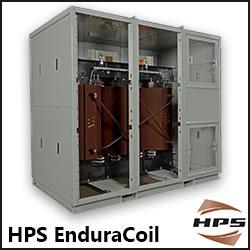
HPS EnduraCoilTM Cast Resin Medium Voltage Transformer
HPS EnduraCoil is a high-performance cast resin transformer designed for many demanding and diverse applications while minimizing both installation and maintenance costs. Coils are formed with mineral-filled epoxy, reinforced with fiberglass and cast to provide complete void-free resin impregnation throughout the entire insulation system. HPS EnduraCoil complies with the new NRCan 2019 and DOE 2016 efficiency regulations and is approved by both UL and CSA standards. It is also seismic qualified per IBC 2012/ASCE 7-10/CBC 2013. Cast resin transformers are self-extinguishing in the unlikely event of fire, environmentally friendly and offer greater resistance to short circuits. HPS also offers wide range of accessories for transformer protection and monitoring requirements.