
SMRs aim to replace traditional carbon-based fuels, aiming to reduce the negative environmental impacts that these fuels cause. This paper evaluates their safety, economics, regulatory frameworks, and environmental impacts based on recent articles and developments.
Small Modular Reactors and Microreactors: A Review of Safety, Economics, Regulation, and Environmental Impacts in Energy Transition
Raj Shah, Parth Patel, Mathew Stephen Roshan, Gavin Thomas | Koehler Instrument Company
ABSTRACT
Small-scale nuclear reactors, including small modular reactors (SMRs) and microreactors, are increasingly proposed as decentralized, low-carbon energy solutions. SMRs aim to replace traditional carbon-based fuels, aiming to reduce the negative environmental impacts that these fuels cause. This paper evaluates their safety, economics, regulatory frameworks, and environmental impacts based on recent articles and developments. Technical advances in modular construction, sealed-core designs, and advanced fuels improve safety and operational simplicity, while lifecycle emissions remain comparable to large reactors and well below fossil fuels. However, challenges related to waste management, including the lack of reliable long-term storage for nuclear waste, and prevailing public skepticism toward nuclear power further constrain its deployment. Future viability depends on cost reductions through serial manufacturing, adaptive regulations, and effective waste solutions.
INTRODUCTION
The global energy transition requires scalable, reliable, and low-carbon alternatives to fossil fuels. While large-scale nuclear power has historically provided baseload electricity, its high capital costs, long construction timelines, and public perception challenges have constrained new development [1]. In response, small-scale nuclear technologies, primarily microreactors and SMRs have gained significant attention as potentially more flexible, deployable, and cost-effective solutions. These systems are designed for modular fabrication, transportability, and enhanced safety features, making them suitable for applications ranging from powering remote communities and industrial facilities to supplementing urban grids [1]. Specifically, interest in marine-based SMRs have emerged, with many countries and corporations developing designs (such as a compact molten salt reactor) for these SMRs [1].
In the feasibility aspect of these SMRs, a potential development of up to a decade refuel-free on a design goal has been indicated in demonstration projects in North America, Europe and Asia, but has not been realized in practice, in the conventional large reactors, which are refueled after every 18 to 24 months [1]. Passive shutdown and compact-box designs are some of the safety improvements, which are a notable change to the previous generations of nuclear technology [1].
The traditional large reactors that were developed in the mid 20th century were normally based on active safety measures which included electrically operated pumps and operator response to ensure the cooling process and therefore were more susceptible to accidents as a result of power interruptions or equipment malfunctions [1]. Large cores in reactors and high-pressure water coolants further complicated the impact of possible failures as was witnessed during the incidents in Three Mile Island and Fukushima. In comparison, SMRs are trying to address these weak points by relying on smaller fuel stocks, passive safety mechanisms, and in certain instances alternative coolants that remove the risks associated with high-pressure systems [1].
This paper synthesizes the latest research to provide a structured evaluation of small-scale nuclear power across four parameters: safety innovations, economic performance, regulatory landscape, and environmental impact. By critically assessing these interrelated factors, the study seeks to clarify whether small-scale nuclear technologies can realistically contribute to residential and distributed energy solutions in the near future.
SAFETY
Small-scale reactor concepts (microreactors and SMRs) rely primarily on a design philosophy of inherent and passive safety. Designers prioritize low-pressure cores, small radioactive inventories, robust physical barriers and passive heat-removal mechanisms (water-cooling) so that a loss-of-power or other off-normal event does not require operator action to avoid core damage [1] . Examples of those passive measures include natural circulation cooling and heat-pipe heat removal [1]. These safety mechanisms, combined with a smaller and more flexible build, make SMRs orders of magnitude safer [1] than traditional large-scale reactors. Some of these mechanisms have been validated (NuScale in 2023), but the validation process is still ongoing for many different designs worldwide [2]. Therefore, it is important to note that many safety mechanisms and designs have not been mass tested, suggesting that SMRs might become unsafe if triggered by specific real-world scenarios, but the overall safety outlook is positive regarding SMRs. Figure 1 shows a model of NuScale’s four module SMR. NuScale claims that this reactor could pair up with a desalination plant and provide all the water necessary for Cape Town South Africa [3].
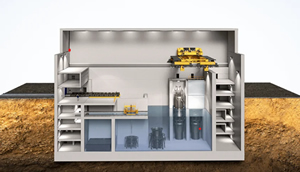
FIGURE 1: NuScale’s 4 module SMR model
Another central element of the safety case for many SMR designs is their use of advanced fuels, particularly TRISO fuel, which stands for TRi-structural ISOtropic particle fuel. Unlike conventional nuclear fuel rods that contain solid uranium pellets, TRISO fuel is made up of thousands of tiny uranium kernels [4]. Every kernel is coated with three protective layers of carbon and ceramic-based materials that act as miniature containment systems [5]. Typical particle diameters are 0.8 – 1 mm, with fuel loading densities (measure of the weight of fuel in an area) in the range of 20%-50% [4]. These coatings are designed to trap radioactive fission products, even at extremely high temperatures [4].
This fuel form is particularly valuable for SMRs because it enhances safety while allowing reactors to operate under different conditions than traditional designs. Conventional fuel like Uranium Dioxide (UO2) can withstand temperatures of 1200 °C. On the other hand, TRISO can withstand temperatures exceeding 1600°C [4], which is far beyond the thresholds encountered in most conceivable accident scenarios for larger reactors and significantly higher than that of UO2. Some SMRs also combine TRISO fuel with inherently safer design choices, such as using helium or molten salt as coolants, operating at low pressures, and being built underground [1]. Together, these features reduce the risk of catastrophic accidents and simplify emergency planning since the reactors are less reliant on external systems to maintain safety. The robustness of TRISO has been documented across decades of testing and is now being incorporated into several advanced microreactor projects. As these designs mature, TRISO’s durability and self-containing properties are expected to play a key role in advancing the reliability and public acceptance of SMRs [4].
Despite these safety benefits there are concerns that emerge. Nuclear reactors calculate emergency planning zones (EPZs), which is the area surrounding the reactor which could be negatively impacted by a failure or major accident in the reactor [7]. While SMRs would have smaller EPZs than larger reactors, the ratio between reactor size and EPZ size, would not be proportional according to a model discussed by the Food and Water Watch [7]. Specifically reducing a reactor’s output by 95% would reduce the EPZ by 92%. Considering that around 20 SMR’s would have to make up for that large reactor, 20 smaller reactors would have a combined larger EPZ than one large reactor, according to the model. This larger area would increase the possibility of human contact within an EPZ, which would be detrimental when a failure does happen.
ECONOMICS
Even if all aspects of SMRs abide by safety standards, if they do not benefit economic growth, they have no viability in society. Fortunately, nuclear power projects in general, especially SMRs, contribute to long-term economic growth through direct, indirect, and induced effects. These labor-intensive projects create high-paying jobs and strengthen local economies but typically take several years to implement due to technical and feasibility constraints. Beyond employment, SMRs support broader national growth by replacing obsolete energy infrastructure and fostering localized supply chains [1]. Especially for large local areas across the United States, the benefits that SMRs could bring are great [1].
For example, a study of five 300 MWe SMR projects in Canada projected a positive impact on GDP of $17 billion Canadian (12.341 billion USD), with government revenues increasing by $5.4 billion Canadian (3.92 billion USD) over 65 years, though these figures are based on economic models, not demonstrated deployments, and exclude decommissioning costs [1]. This suggests countries with existing nuclear industries are likely to see significant benefits from SMR deployment due to local participation in construction, operations, and supply chains (although this is not definitive). These projections give reason to invest in SMR development, because of the possibility of great revenue growth from the SMRs [1].
An additional advantage is that the small scale of SMRs reduces financial and operational risks compared to traditional gigawatt-scale nuclear plants. Because they require less upfront capital and can be deployed incrementally, investors and governments face lower exposure to cost overruns or delays [1]. This smaller footprint also makes SMRs more flexible, allowing them to adapt to varying regional demands without the same economic vulnerabilities associated with large-scale nuclear development. Especially for smaller countries with smaller economies (like in the Pacific Islands), they can adopt SMRs with more ease, than bigger and less flexible larger reactors. Even in nations without substantial nuclear manufacturing capacity, SMRs can positively influence the economy by improving grid reliability, resilience, and affordable electricity production (theoretical goals). These attributes can stimulate broader economic activity by reinforcing the income-consumption loop and ensuring predictable, sustainable energy supply.
However, much of this information and economic data are theoretical and would not necessarily be guaranteed to be met in real-life applications. Traditional large-scale projects have proven to be financially risky, causing hesitation from investors. Specifically, nuclear projects have a high risk of ending up in a loss of capital, often incurring costs that exceed the returns they generate. [2]. As a result, it is imperative to account that wide-scale development of SMRs do have the possibility to backfire and become a financial burden. However, it is equally important to consider them economically viable, leading to a mixed and nuanced viewpoint of the economic impacts of SMRs.
REGULATIONS
In the United States, the regulation of SMRs is overseen by the Nuclear Regulatory Commission (NRC), which has developed frameworks specifically to address the novel characteristics of SMRs. Unlike conventional gigawatt-scale reactors, SMRs employ modular designs, advanced passive safety systems, and reduced fuel inventories, which require tailored regulatory pathways. In 2019, the NRC issued guidance for Part 50 (construction permit and operating license) and Part 52 (combined license) applications that explicitly incorporate provisions for SMRs [6]. As of now, only a few number of SMRs have been approved by the NRC (such as NuScale’s design). This includes considerations for modular construction, factory fabrication, and phased deployment. Furthermore, the NRC’s Advanced Reactor Policy Statement highlights the need for risk-informed, performance-based approaches rather than prescriptive rules designed for older large-scale plants. These regulatory shifts are meant to reduce unnecessary burdens while ensuring robust safety standards [6]. Despite the seemingly slow progress of SMR approval, the IAEA (International Atomic Energy Agency) is working on getting more SMR designs approved in the future.
Federal legislation also plays an important role in shaping SMR deployment. The Nuclear Energy Innovation and Modernization Act (NEIMA) of 2019 directed the NRC to modernize its fee structure and licensing framework for advanced reactors, including SMRs. Similarly, the Inflation Reduction Act of 2022 provided incentives for clean energy technologies, indirectly benefiting SMR projects by recognizing nuclear power’s low-carbon credentials. The Department of Energy (DOE) has additionally supported SMR demonstration projects, such as NuScale’s VOYGR reactors, through cost-sharing agreements. These combined federal efforts demonstrate that the United States is actively creating a regulatory and economic environment conducive to the safe and timely deployment of SMRs, though challenges remain in ensuring consistency between federal oversight and state-level energy policies. [6]
Furthermore, international harmonization of nuclear regulations could be a major enabler for the growth of SMRs by creating clearer, more consistent rules across countries. As of now, every nation has its own licensing process, which slows down deployment and makes it harder for developers to operate globally. If countries worked toward common standards, designs approved in one market could be more easily recognized in others, reducing costs and delays. This consistency would also give investors greater confidence that projects are not at risk of regulatory setbacks, which could make financing more accessible. Harmonized approaches could encourage the development of shared supply chains, where components and expertise flow more easily across borders. Policies around fuel handling and waste management could also be coordinated, making it easier to build regional solutions instead of leaving every operator to handle these challenges alone. On a broader scale, international alignment would help create predictable markets where companies can focus on innovation rather than navigating different sets of rules. It could also improve public trust, since agreement among multiple regulators signals that safety and oversight are being taken seriously. In the long term, harmonization would not just simplify regulation but also create the kind of stable policy environment that allows SMRs to transition into widespread adoption.
ENVIRONMENTAL IMPACTS
The environmental benefits of SMRs largely stem from their ability to generate low-carbon electricity with a much smaller land footprint compared to renewable alternatives such as solar or wind farms. SMRs emit virtually no greenhouse gases during operation, making them a critical technology for decarbonizing grids and complementing intermittent renewable sources [1]. Their compact size enables placement closer to demand centers, reducing the need for extensive transmission infrastructure. In addition, many SMR designs incorporate passive cooling systems that minimize water use relative to traditional large reactors, lowering the ecological impact on aquatic ecosystems. Advanced fuel cycles under development may also allow for more efficient use of uranium, reducing mining requirements and long-term waste volumes. Collectively, these factors position SMRs as a scalable solution for meeting climate targets while minimizing environmental disruption [1].
Despite these advantages, SMRs still face environmental challenges. Nuclear waste remains a central concern, as even small reactors produce spent fuel that requires secure, long-term storage. High-level nuclear waste primarily consists of spent nuclear fuel from power plants, which contains highly radioactive fission products and elements. This waste is extremely dangerous because it emits ionizing radiation that can cause cellular damage, leading to severe health issues like cancer. Some of these radioactive elements, such as plutonium-239, have incredibly long half-lives, meaning they remain hazardous for thousands of years [8]. The most widely accepted method for long-term disposal is deep geological disposal, which involves burying the waste hundreds of meters underground in stable rock formations to isolate it from the environment [8]. However, these containment methods are not completely secure due to the difficulty of guaranteeing geological stability over such vast timescales and the potential for containers to corrode and leak, allowing contaminants to reach groundwater.
Although SMRs generate less waste per unit of electricity, the absence of a permanent geologic repository in the United States complicates disposal plans [7] As a result, if SMRs become rapidly developed in the United States, it would be difficult to accommodate them long term. The modular nature of SMRs also means that large-scale deployment could multiply the number of sites requiring radiological oversight, which may increase the cumulative risk of accidents or leaks during transport and operation [7]. Another challenge is the emissions associated with the nuclear lifecycle. A Life Cycle Assessment (LCA) evaluates all emissions generated during the entire lifespan of a reactor, including uranium mining, fuel enrichment, plant construction, operation, and decommissioning. While operational emissions are negligible, upstream processes such as mining and enrichment can be carbon-intensive. If not managed carefully, these lifecycle activities could reduce some of the climate advantages of SMRs [7]. The drawbacks could get so severe that they could render SMRs becoming only marginally cleaner than regular nuclear fuel.
Furthermore, SMRs may require significant water withdrawals during operation. In fact, according to the Food and Water Watch, nuclear energy uses twice as much water as natural gas, to produce the same amount of energy [7]. Figure 2 compares this amount of water consumption between Natural Gas and Nuclear, while also providing other energy sources like coal, wind, and solar. This water consumption could be extremely detrimental since the water discharged from SMRs can carry contaminants that reduce overall water quality and threaten aquatic ecosystems [7]. Over time, these pollutants can harm fish populations, disrupt food chains, and decrease biodiversity in sensitive environments. This creates long-term risks for communities that rely on nearby water sources for drinking, fishing, or agriculture [7]. The scale of water use also means that even low levels of contamination can accumulate and cause significant ecological stress. Especially if these effects were to occur near large cities or densely populated suburbs, the effects listed could dangerously deteriorate human quality of life and wellbeing. Currently, SMRs may not be the most environmentally viable option, but faster future technologies develop, it could help mitigate the massive water amount that SMRs are projected to consume.

FIGURE 2: Table of water consumption by energy technology from the Food and Water Watch[1]
CONCLUSION
The discussion of small modular reactors (SMRs) highlights both their promise and their unresolved challenges. While advanced fuels like TRISO, modular construction, and passive safety features improve the safety and flexibility of nuclear energy, these strengths do not guarantee immediate deployment at scale. The central trade-off is between potential long-term benefits, such as reliable low-carbon energy and reduced land use, and short-term barriers like high costs, regulatory delays, and uncertainties surrounding waste management. For policymakers and industry leaders, this raises the question of whether SMRs should be prioritized now or whether investment should first focus on solving critical barriers that continue to hinder their competitiveness.
To move toward viability, several areas require further research and strategic attention. First, economic feasibility will hinge on proving that standardized modular designs can achieve genuine cost reductions through serial production. Second, regulatory pathways need to balance rigorous safety standards with processes that are streamlined enough to encourage innovation without unnecessary delays. Third, environmental concerns such as long-term waste storage and lifecycle emissions demand robust solutions to build public trust and ensure sustainability. Each of these gaps points to the need for collaborative research between governments, private industry, and international organizations.
Ultimately, SMRs should not be seen as a near-term replacement for existing power sources but as a longer-term option that could fill specific roles in a diversified energy system. They may be most effective when targeted at remote regions, industrial applications, or hybrid systems that pair nuclear with renewables. Pursuing SMRs now is less about immediate deployment and more about laying the groundwork for future viability. If research priorities are aligned with economic and environmental realities, SMRs could evolve from a promising concept into a practical and trusted contributor to the low-carbon transition.
 Dr. Raj Shah, is a Director at Koehler Instrument Company in New York, where he has worked for the last 25 plus years. He is an elected Fellow by his peers at ASTM, IChemE, ASTM, AOCS, CMI, STLE, AIC, NLGI, INSTMC, Institute of Physics, The Energy Institute and The Royal Society of Chemistry.
An ASTM Eagle award recipient, Dr. Shah recently coedited the bestseller, “Fuels and Lubricants handbook”, details of which are available at ASTM’s Long-awaited Fuels and Lubricants Handbook https://bit.ly/3u2e6GY. He earned his doctorate in Chemical Engineering from The Pennsylvania State University and is a Fellow from The Chartered Management Institute, London. Dr. Shah is also a Chartered Scientist with the Science Council, a Chartered Petroleum Engineer with the Energy Institute and a Chartered Engineer with the Engineering council, UK.
Dr. Shah was recently granted the honorific of “Eminent engineer” with Tau beta Pi, the largest engineering society in the USA. He is on the Advisory board of directors at Farmingdale university (Mechanical Technology), Auburn Univ (Tribology), SUNY, Farmingdale, (Engineering Management) and State university of NY, Stony Brook (Chemical engineering/ Material Science and engineering).
An Adjunct Professor at the State University of New York, Stony Brook, in the Department of Material Science and Chemical Engineering, Raj also has over 725 publications and has been active in the energy industry for over 3 decades. More information on Raj can be found at https://shorturl.at/JDPZN
Mathew Roshan is a Chemical and Molecular Engineering Undergraduate Student at Stony Brook University where he is a research assistant at the Advanced Energy Research and Technology Center performing research on carbon capture and hydrogen storage. He also works as an intern under Dr. Raj Shah studying advanced fuel technology at Koehler Instrument Company and is a member of the SBU chapter of the American Institute of Chemical Engineers (AIChE).
Parth Patel, Mathew Stephen Roshan, Gavin Thomas are interns working on alternative energy based projects at Koehler Instrument Company in Holtsville, NY
Sources
- International Atomic Energy Agency. (2024). small modular reactors: Advances in SMR development. (https://www-pub.iaea.org/MTCD/Publications/PDF/p15790-PUB9062_web.pdf)
- Lee, J. I. (2024, April 3). Review of Small Modular Reactors: Challenges in Safety and Economy to Success. (10.1007/s11814-024-00207-0)
- NuScale. The NuScale Power Module. nuscalepower.com https://www.nuscalepower.com/products/nuscale-power-module
- Forsberg, C., & Kadak, A. (2024, August 11). Reducing Proliferation Risks with High-Assay Low-Enriched Uranium Fuels in Reactors with Coated-Particle (TRISO) Fuels. (https://www.tandfonline.com/doi/full/10.1080/00295450.2025.2462378)
- Office of Nuclear Energy. TRISO particles: The most robust nuclear fuel on earth (2019). art.inl.gov (art.inl.gov (https://www.nrc.gov/docs/ML2114/ML21140A413.pdf)
- United States Nuclear Regulatory Commission. (2024). Part 53 – Risk Informed, Technology-Inclusive Regulatory Framework for Advanced Reactors. nrc.gov. (https://www.nrc.gov/reactors/new-reactors/advanced/modernizing/rulemaking/part-53)
- Food and Water Watch. (2025, June). Going Nuclear in the Neighborhood: The Dangers of Small Nuclear Reactors. foodandwaterwatch.org. (https://www.foodandwaterwatch.org/wp-content/uploads/2025/06/2506_FSW_GoingNuclear.pdf)
- World Nuclear Association. Radioactive Waste Management. https://world-nuclear.org/information-library/nuclear-fuel-cycle/nuclear-waste/radioactive-waste-management
The content & opinions in this article are the author’s and do not necessarily represent the views of AltEnergyMag
Comments (0)
This post does not have any comments. Be the first to leave a comment below.
Featured Product