
Global Solar Tracker Market Report 2030 – Size, CAGR, Leading Players & Regional Insights
Solar Tracker Market demand continues to rise with growing renewable energy capacity and government incentives. The industry benefits from automation, IoT integration, and advances in single-axis and dual-axis tracking systems, helping utility-scale projects achieve higher power output and investment returns.
Solar Tracker Market: Powering the Next Era of Renewable Energy Efficiency
More Headlines
- Clean Energy Market Growth Analysis: Wind, Solar, Hydropower, Geothermal and Regional Trends
- Energy Storage as a Service Market Size, Growth Opportunities, and Future Forecast to 2032
- Case Study - KST-1P Solar Tracker Powers Mexico's Clean Energy Transition
- EXERGY UNVEILS GEMINI TURBINE: THE NEW FRONTIER IN LARGE-SCALE GEOTHERMAL POWER GENERATION •
- Solar Photovoltaic Glass Market Growth Driven by Smart Buildings and Solar Roads

The global Solar Tracker Market is at the heart of a revolution reshaping the way the world generates and consumes solar energy. As the clean energy transition accelerates, solar power is no longer just about installing panels—it's about how efficiently those panels can follow the sun. That's where solar tracking systems step in, enhancing power output, reliability, and returns on investment for utilities and developers alike.
According to Ameco Research's Solar Tracker Market Report , the market was valued at USD 3.8 billion in 2021 and is projected to reach an impressive USD 28.9 billion by 2030, growing at a remarkable CAGR of 25.4% between 2022 and 2030. Such exponential growth signals how integral tracking technology has become in maximizing solar energy production and optimizing asset performance.
What is a Solar Tracker and Why It Matters
A solar tracker is a device that orients solar panels toward the sun throughout the day, ensuring the panels capture the maximum possible solar radiation. Unlike fixed installations, trackers dynamically adjust panel angles based on the sun's position, significantly increasing energy yield—sometimes by 20-30%.
In the evolving Solar Tracker Market, this ability to generate more energy from the same installed capacity has become a game-changer for utility-scale projects. By integrating advanced control systems, sensors, and data analytics, modern trackers enhance performance while lowering levelized cost of electricity (LCOE)—making solar energy even more competitive with conventional power sources.
Understanding the Solar Tracker Market Size and Growth Drivers
The Solar Tracker Market Size has expanded rapidly over the past decade due to a convergence of favorable policy frameworks, technology advancements, and surging renewable energy investments. A growing global consensus toward carbon neutrality and the affordability of solar technologies have positioned trackers as essential infrastructure components.
Several key drivers are shaping Solar Tracker Market Growth:
1. Rising Global Solar Installations
As countries push toward aggressive renewable targets, solar installations are scaling up dramatically. Trackers are now standard in most large-scale utility projects, driven by their ability to enhance output without expanding land requirements.
2. Declining Costs of Solar Components
The consistent decline in module prices and improvements in tracker manufacturing processes have made high-efficiency solar systems more accessible. Lower costs are boosting Solar Tracker Market Share across developing economies, where energy affordability is crucial.
3. Technology Innovation and Digital Integration
The integration of IoT sensors, AI-based predictive maintenance, and cloud-based monitoring systems are transforming traditional solar farms into smart, data-driven energy assets. Intelligent tracking solutions reduce downtime, improve precision, and extend operational lifespan.
4. Supportive Government Policies
Global clean energy agendas—such as the U.S. Inflation Reduction Act, India's National Solar Mission, and the EU's Fit for 55 package—are encouraging rapid adoption of solar trackers by offering incentives, subsidies, and tax benefits to solar developers.
Single-Axis vs Dual-Axis: The Core of Market Segmentation
The Solar Tracker Market Analysis reveals two primary product categories: single-axis and dual-axis trackers.
• Single-axis trackers rotate panels on one axis, typically from east to west, following the sun's daily path. They dominate the market due to lower cost, simpler mechanics, and proven reliability across large utility-scale deployments.
• Dual-axis trackers, though more expensive, adjust panels both horizontally and vertically to capture maximum sunlight year-round. They are particularly advantageous in high-latitude regions or smaller installations that demand peak efficiency.
According to Ameco Research, single-axis systems accounted for a major portion of the global Solar Tracker Market Share in 2021, supported by widespread adoption in North America, the Middle East, and Latin America.
Utility vs Non-Utility Applications
Utility-scale solar farms remain the backbone of the Solar Tracker Market, representing the majority of installations worldwide. These large projects depend on trackers to achieve higher capacity utilization and greater power consistency.
However, the non-utility segment—including commercial and industrial users—is growing steadily. Businesses across manufacturing, logistics, and data center operations are adopting solar trackers to reduce energy costs and meet sustainability commitments.
Regional Insights: Who Leads the Solar Tracker Market?
North America: The Undisputed Leader
North America holds the largest Solar Tracker Market Share, primarily led by the United States. The region's robust policy framework, advanced manufacturing capabilities, and growing demand for grid-scale solar installations have driven market maturity.
Federal incentives, state-level renewable portfolio standards, and the Inflation Reduction Act continue to accelerate project deployment. Major players like Nextracker, Array Technologies, and First Solar are heavily investing in innovation and supply chain expansion.
Europe: Focused on Efficiency and Sustainability
Europe's Solar Tracker Market Trends are influenced by the EU's decarbonization goals and strong emphasis on efficiency optimization. Countries such as Spain, Italy, and France are integrating trackers into large PV projects to improve grid stability and renewable penetration.
Ongoing efforts to reduce dependency on fossil fuels are creating new opportunities for tracker manufacturers that can deliver durable, weather-resistant systems suited for diverse European climates.
Asia-Pacific: Fastest-Growing Regional Market
The Asia-Pacific region represents the most dynamic growth zone for the Solar Tracker Market. China, India, Japan, and Australia are leading the charge with vast solar capacity expansions.
India's large-scale solar parks—like the Bhadla Solar Park and Pavagada Solar Project—showcase the region's appetite for scalable and cost-effective solar tracker systems. Government-backed tenders, coupled with an urgent need for energy security, are fueling market acceleration across Asia.
Latin America and Middle East & Africa: Emerging Markets
Latin America, particularly Brazil and Chile, is experiencing significant solar development due to favorable irradiation and policy support. Similarly, the Middle East & Africa region—led by Saudi Arabia and the UAE—is embracing solar trackers for large desert-based solar farms, taking advantage of abundant sunlight and falling technology costs.
Key Companies in the Solar Tracker Market
Competition in the Solar Tracker Market is intense and innovation-driven. Major industry participants focus on partnerships, new product launches, and technology integration to enhance market positioning.
Prominent companies include:
• Array Technologies, Inc.
• NEXTracker, Inc.
• First Solar, Inc.
• Arctech Solar Holding Co., Ltd.
• Soltec Power Holdings S.A.
• PV Hardware Solutions S.L.
• Convert Italia S.p.A.
• STI Norland
• GameChange Solar
• Mecasolar
Many of these players are integrating digital monitoring solutions, predictive analytics, and hybrid control systems to improve system performance and reliability. For example, Nextracker's smart solar trackers equipped with machine learning algorithms optimize tilt angles in real time, increasing energy yield even under partial shading or cloud cover.
Recent Developments Shaping Solar Tracker Market Trends
The Solar Tracker Market Analysis highlights a wave of recent developments:
• Increased vertical integration by leading manufacturers to reduce supply chain dependencies.
• Launch of AI-enhanced trackers capable of autonomous performance optimization.
• Expansion of tracker exports from Asia to Europe and Latin America.
• Partnerships between energy developers and software firms to deliver data-driven O&M solutions.
These developments reflect a clear trend: the Solar Tracker Market is moving beyond mechanical innovation into the realm of smart energy ecosystems.
Government Support and Policy Landscape
Supportive policies play a central role in Solar Tracker Market Growth.
In the U.S., federal tax credits under the IRA encourage tracker adoption in utility-scale solar projects.
In India, subsidies and renewable purchase obligations (RPOs) are driving developers to integrate advanced trackers to meet efficiency benchmarks.
Europe's clean energy targets under the Green Deal further amplify demand by linking project financing to system efficiency metrics.
Globally, governments are promoting local manufacturing, offering incentives for domestic production of trackers, and streamlining land acquisition for solar projects—all contributing to market expansion.
Challenges Hindering Market Growth
Despite robust prospects, the Solar Tracker Market faces a few challenges:
• High upfront investment costs for dual-axis trackers.
• Complex installation and maintenance requirements in regions with rough terrain.
• Supply chain bottlenecks for components like motors and control units.
• Weather-related performance risks, such as wind loads and extreme climates.
Nevertheless, ongoing innovation in design, material durability, and digital monitoring is mitigating these challenges, enabling broader adoption even in less favorable environments.
Future Outlook: The Decade of Smart Solar Tracking
The Solar Tracker Market Report paints a promising picture for the coming decade. As renewable energy becomes central to global power generation, the role of smart tracking systems will grow even more critical.
By 2030, solar trackers are expected to be standard across nearly all utility-scale projects, with dual-axis systems gaining traction in emerging markets. The fusion of hardware, AI, and predictive analytics will define the next phase of solar energy optimization—making trackers not just mechanical aids but intelligent energy partners.
Moreover, hybrid tracker systems that integrate energy storage will emerge as a powerful solution for stabilizing grid supply and supporting 24/7 renewable power delivery.
The Solar Tracker Market stands at the intersection of technology, sustainability, and innovation. As solar energy continues its rise as a mainstream power source, trackers are redefining efficiency standards for developers, investors, and policymakers worldwide.
Driven by rapid Solar Tracker Market Growth, supportive government initiatives, and continued digital transformation, the industry's trajectory is set firmly upward. The coming years will see an ecosystem where solar trackers are not merely optional components but essential enablers of global clean energy ambitions.
Request a comprehensive Sample Pages of Solar Tracker Market Report by Ameco Research for a deeper understanding of how this transformative technology is shaping the global energy landscape.
Featured Product
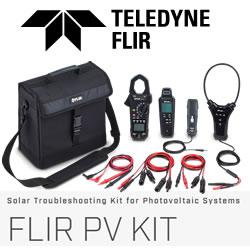
FLIR PV KIT - Solar Troubleshooting Kit for Photovoltaic Systems
FLIR PV kits are designed to assess the performance, safety, and efficiency of residential, commercial, and industrial solar panels and photovoltaic systems. PV kits from FLIR help you diagnose faults and potential failures and ensure optimal energy production, system longevity, and compliance with industry standards. With a PV kit from FLIR, you'll be perfectly equipped for any solar installation or repair.