
NEW REPORT SHOWS HOW RENEWABLE ENERGY IS RESHAPING UTILITIES
Conducted by the Solar Electric Power Association (SEPA) and ScottMadden Inc., the survey is the first to systematically look at how renewable energy is reshaping utilities' organizational structures -- including hiring practices -- as increasing levels of wind, geothermal and biomass, as well as solar energy, are integrated onto the grid.
WASHINGTON, DC., September 24, 2014 -- Solar energy, particularly distributed photovoltaic (PV) generation, drives more full-time utility employment than any other renewable generating resource. A new survey of 14 utilities found that they averaged 41 full-time equivalent (FTE) employees per 100 megawatts (MW) of PV interconnections versus 12 FTEs per 100 MW of total renewable capacity.
More Headlines
- MATRIX RENEWABLES SIGNS FULL EPC AGREEMENT WITH TESLA FOR LANDMARK STANDALONE BATTERY ENERGY STORAGE PROJECT IN THE UK
- Solar Lights Market Growth Driven by Infrastructure and Smart City Projects
- Autonomous inspection of photovoltaic panels
- Decarbonization Market Outlook: Driving the Global Shift Toward a Low-Carbon Economy
- Battery Technology Market Growth: Powering the Future of Energy Storage and Electrification

Conducted by the Solar Electric Power Association (SEPA) and ScottMadden Inc., the survey is the first to systematically look at how renewable energy is reshaping utilities' organizational structures -- including hiring practices -- as increasing levels of wind, geothermal and biomass, as well as solar energy, are integrated onto the grid.
To meet the technical challenges of renewables integration, these companies now find they must develop new areas of expertise and departmental structures, often working across traditional groups and job functions. In another key survey result, the report identifies three distinct stages of internal reorganization that utilities pass through as they add more renewables to their energy mix.
Stage 1: The early, reactive stage occurs when a utility has a limited number of distributed solar interconnections or is beginning to meet a state-mandated renewable energy targets. The company maintains its traditional organizational structures, reacting to changing situations and needs as they arise.
Stage 2: With an increasing number of renewable interconnections, a utility's internal restructuring becomes proactive. Dedicated renewable energy groups are formed with staff from existing groups, and renewables are integrated into strategic planning and business development.
Stage 3: With high numbers of interconnections -- both distributed and utility-scale -- renewables are no longer a niche, but a core organizational component seen as a source of business opportunities. Renewable procurement hardly differs from that of other resources.
"Utilities are finding that they must have the same willingness to innovate and collaborate on internal restructuring as they are applying to the technical challenges triggered by solar and other renewables," said Julia Hamm, SEPA's president and CEO. "These changes also underline the critical need for a well-trained workforce combining top technical and business skills."
A free Executive Summary of the report, "How Renewable Energy Is Reshaping the Utility Hierarchy," can be found on the SEPA website at www.solarelectricpower.org.
Featured Product
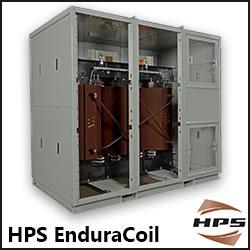
HPS EnduraCoilTM Cast Resin Medium Voltage Transformer
HPS EnduraCoil is a high-performance cast resin transformer designed for many demanding and diverse applications while minimizing both installation and maintenance costs. Coils are formed with mineral-filled epoxy, reinforced with fiberglass and cast to provide complete void-free resin impregnation throughout the entire insulation system. HPS EnduraCoil complies with the new NRCan 2019 and DOE 2016 efficiency regulations and is approved by both UL and CSA standards. It is also seismic qualified per IBC 2012/ASCE 7-10/CBC 2013. Cast resin transformers are self-extinguishing in the unlikely event of fire, environmentally friendly and offer greater resistance to short circuits. HPS also offers wide range of accessories for transformer protection and monitoring requirements.